Missing From the Annals of Westbrook Police History,
A Murder Along County Road
The Victim Dies in Police Custody
Shooter in the Wind
The pastoral setting of what we know today as Smiling Hill Farm erupted in a roar of angry and drunken voices punctuated by gunfire. First one shot, and then four in rapid succession. When Roscoe Knight peered into the rain and darkness of that October night of 1902, he could see nothing. The county road wending its way from Portland to Coal Kiln Corner and beyond was empty.
Presuming that the ado had taken place amongst men traveling by wagon, occupants of the house owned by Benjamin Knight settled back until two hours or so later. Pounding at the door once again shattered the calm. Wary due to the earlier gunfire, both Benjamin and Roscoe Knight, father and son, were fully armed when they cracked open the door. “For God’s, sake don’t shoot. I’ve been shot myself, and can do no harm,” cried John Lynch.
When the door was opened the wounded and drunken man fell into the house. Muddied and blood oozing from a wound on his wrist, he would claim to have been traveling to Portland from Manchester, New Hampshire when he was accosted and robbed by a group of men. He also had a wound to his back just above the hip.
At the time of the incident, October 28, 1902, the Knight abode was set back from the road, located near where today a tranquil pond and a copse of stately trees welcomes visitors. The edifice up the hill and closer to the road, commonly called the Knight Place today, was erected in 1916.
Roscoe (age 19) hooked up a rig and went to Westbrook Police Station, which was then located on the second floor of the Vallee block at Main and Bridge Streets. There he fetched special officer N.V. Pomerleau, who accompanied him back to the farm.
After interviewing the wounded man, the officer made a search of the property, discovering that the blacksmith shop had been burgled. Missing were a cold chisel, a broad axe, and a bit stock, all handy tools for breaking and entering or assaulting a safe.
Lynch, who had somewhat recovered and was able to sit up, was transported to the Westbrook Police station. There the wounded man was questioned by City Marshall White and Officer Pomerleau. He maintained his story of being robbed. However, in his pockets were found 18 cigars and a portion of a stick of dynamite, leaving no doubt of Lynch’s complicity in a burglary.
As he lay on a cot covered with a blanket in the reception area of the police station, various Westbrook citizens filed past. Some of whom stated that they believed this John Lynch was a man they had seen in Portland. One, Wardsworth Spring, said that he knew Lynch as an inmate at the county jail. It was then the name William Thompson came to light. Deputy Frith later confirmed the identity of the man who had until recently acted as a barber in the jail.
Attended by doctors Horr and Smith, it was deemed unnecessary to transport the balding forty-year-old man to a hospital, believing he would be able to appear in court within a few days. Lynch or Thompson was repeatedly asked who had shot him. According to one newspaper account, which appears erroneous, he named James Arnold known to the police as Boston Shorty.
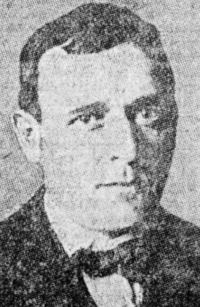
aka Boston Shorty
Hampered by darkness, special officer Pomeleau had asked the Knights to make a more thorough search with the coming of daylight. This was done, and a meal bag labeled G. W. Sherman was found lying in the roadway. It contained shoes, rubbers, mittens, and tobacco. Sherman’s store was located at what is known colloquially as Coal Kiln Corner, in Scarborough, approximately a half mile from the Knight farm. It was in the building where Sirloins restaurant and Butcher shop now resides.
A bit later in the morning Benjamin Knight arrived at G.W. Sherman’s Store, where he found the missing tools from his blacksmith shop had been used to enter the store and attempted to open the safe. It was theorized that the hapless burglars, unable to open the safe were left to pilfer the shelves and then fell into an argument over the loot.
What we would call an all-points-bulletin was issued, and Portland Police were notified of the investigation in Westbrook. They provided information on the known associates of John Lynch, who was also known to them as Billy Riley and William Thompson. They were as follows: James Ryan, William Smith, and James Arnold.

It was soon determined that James Ryan had been absent from the area for a time, and the investigation into his involvement was terminated. Ironically, the capture of William Smith was affected by a reporter for the Portland Evening Express, who arranged for him to meet with the District Attorney Whitehouse to give details of his alibi for the time of the burglary.
With corroboration from his land lady, Mrs. Murray of 51 Preble Street, it was established that he had most recently arrived from Montreal and had taken a room with her. According to her testimony she had let him in from the locked door in the evening, and he had not gone out again, making it nearly impossible for him to be anywhere near Coal Kiln Corner. Canadian authorities were later to seek extradition of Smith for burglaries he allegedly committed in Montreal.
Arnold at five feet and one quarter inches tall, known to the police as Boston Shorty was the reputed leader of a gang of “hobo burglars.” He became the focus of the investigation, leading to Sherriff Dunn of Cumberland County on a tramp across remote sections of Maine in hopes of bringing him to justice. It was not to be.
Arnold resurfaced in 1904, charged with burglary of a residence in Saco. He was arrested and jailed awaiting trial. He, with another prisoner, overpowered jailer, Francis Murphy, nearly killing him and locking him in the cell. They made their escape, guided by a local youth, in hopes of reaching a lumber camp where they could hide out. It was snowing and knee deep with temperatures at twenty below. They were recaptured, and Arnold would end up serving six years in Thomaston State prison on the charge of burglary. He remained a life-long criminal and was arrested and convicted of breaking into railroad stations along the Kennebec River belonging to Central Maine Railroad in September of 1925.
At around noon Lynch’s condition went into steep decline, and he died of his wounds about two o’clock. The mortal coil of the man of several identities was put to rest by the Roberts and Hodson funeral services, located on Main Street in Westbrook. Where his body lies is not known, but likely in an unmarked pauper’s grave. Many such graves were located at the Poor Farm, in the general area of what is today public services garage on Saco Street.
But what is more of a mystery is: Who was this man?
The Boston Daily Globe of February 6th, 1896 reports the court appearance of a youthful William Thompson, who had recently been released from the South Boston House of Correction, where had done time under the name of William Smith. his real name being Valentine Robinson.
I thank Clyde Chapman of Westbrook’s Historical Society’s “Bucket Brigade” for alerting me to this story. And thanks to Marsha Knight and Darlene Hall for their remembrances and family lore.
 Ammoncongin Observer